Archives
- March 2026 (3)
- January 2026 (4)
- September 2017 (2)
- August 2017 (1)
- October 2016 (1)
Categories
- In the News (7)
- Press Releases (6)
World’s First Human Clinical Trial demonstrating Protection from microplastics. Their lead innovation, Qi601, represents a novel postbiotic designed to act as a physical barrier within the body. In first-in-human clinical use, Qi601 has demonstrated the ability to bind microplastic particles in the mouth—addressing exposure at its earliest point of entry—and supporting a new paradigm of preventing absorption through microbiome-inspired defense rather than systemic intervention.
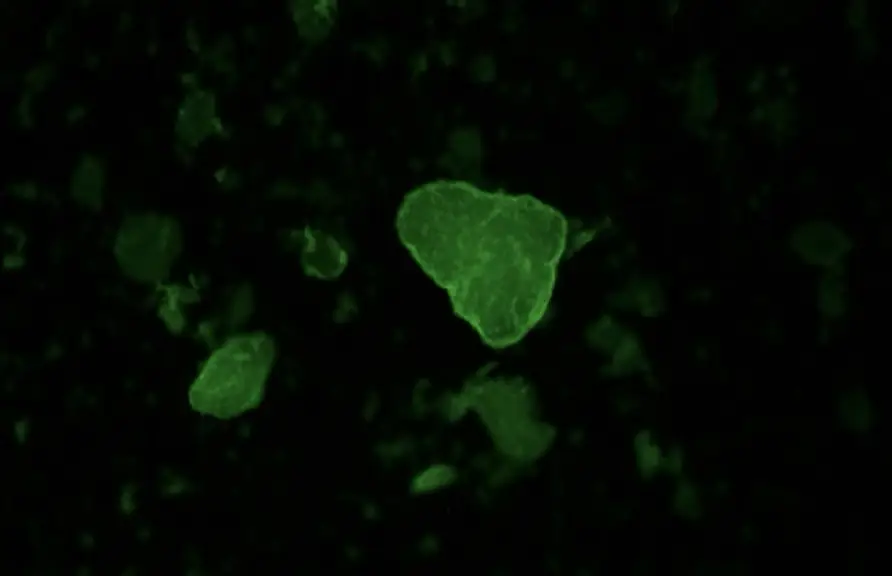
A five-participant interventional crossover human study demonstrated that Qi601® physically binds with microplastic particles released during gum chewing under microscopic analysis. Follow-on laboratory digestion simulations exposing Qi601-bound nanoplastics to sequential saliva, gastric, intestinal, and colonic fluids showed ~98% retention of bound nanoplastics compared with untreated controls, supporting stability of the Qi601 binding matrix through modeled gastrointestinal digestion.
Follow-on laboratory digestion simulations exposing Qi601-bound microplastics to sequential saliva, gastric, intestinal, and colonic fluids showed ~98% retention of bound nanoplastics compared with untreated controls, supporting stability of the Qi601 binding matrix through modeled gastrointestinal digestion.
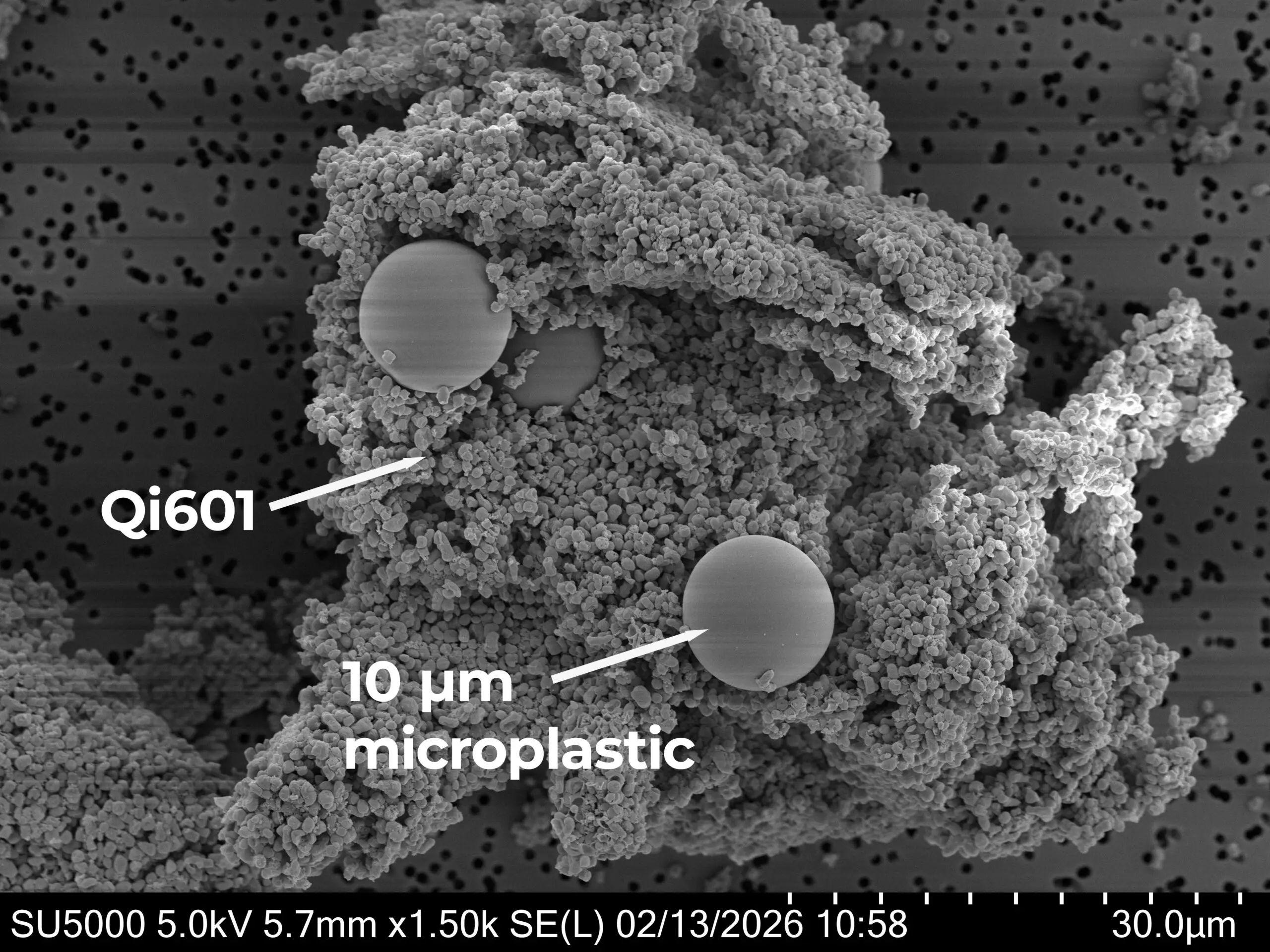
This scanning electron microscopic image above shows that Qi601 forms small rough, bumpy clusters that look like tiny pebbles.Qi601 surrounds and binds the plastic spheres. The Qi601 structure holds onto these plastics spheres all the way through the digestive system, as proven in laboratory studies. This shows that Qi601 can capture and hold onto nanoplastics at a very small scale.
If microplastics can’t attach to your cells, they can’t be absorbed into your body. That’s why Qi601 acts as a first line of defense—helping stop nanoplastics before they enter your system.
Share