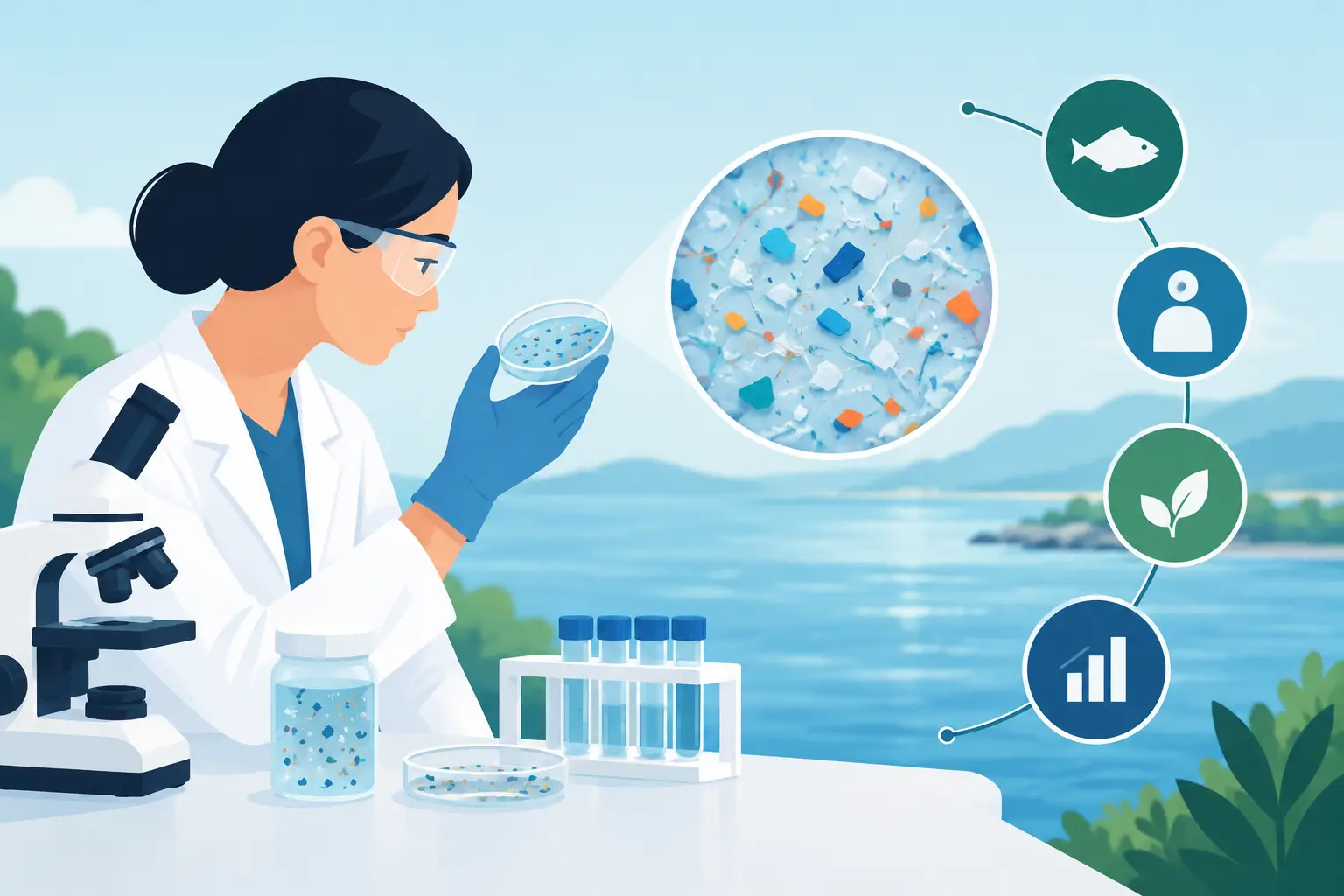
Plastic is no longer only an environmental problem. It is a personal exposure problem. Researchers are finding microplastic particles in human samples that were once considered protected from the waste stream: blood, stool, lung tissue, placental tissue, and more. That is why microplastic biomonitoring trends matter. They show how science is moving from asking whether plastic enters the body to asking where it goes, how long it may remain, and what meaningful protection should look like.
The answers are not settled yet. Human microplastic research is young, methods differ, and detecting a particle does not automatically prove it caused a health condition. But the direction is clear: plastic exposure is measurable, widespread, and increasingly difficult to dismiss as someone else’s problem.
Microplastic Biomonitoring Trends Are Getting More Personal
Biomonitoring means measuring a substance or its effects in biological samples. For microplastics, that can include stool, blood, urine, sputum, tissue, or other human samples. It is a major shift from measuring plastic only in bottled water, seafood, household dust, or outdoor air.
Environmental monitoring can tell us where particles are present. Biomonitoring asks a more immediate question: what has actually crossed into, passed through, or remained associated with the human body?
This distinction matters because exposure is not identical for everyone. Two people can live in the same city and have very different contact with plastic particles based on food storage, drinking-water source, occupation, household dust, diet, cooking habits, and digestive health. Biomonitoring brings the conversation closer to real life.
It also makes the threat harder to ignore. Plastic does not need to be visible to enter a daily routine. It can be in the water you drink, the food you heat, the air you breathe, and the packaging that touches nearly everything you consume.
The Biggest Changes in Microplastic Biomonitoring
Researchers are looking beyond stool samples
Stool testing has been a logical early focus because the digestive tract is a primary route of exposure and elimination. Finding particles in stool can demonstrate that ingested plastic has moved through the gastrointestinal system. It does not, by itself, reveal how much entered circulation or interacted with tissues.
That limitation is driving interest in multiple sample types. Blood studies explore whether particles or particle-associated materials may reach circulation. Lung-related samples help investigators understand inhalation exposure. Tissue studies examine whether particles can be detected in specific areas of the body. Each sample answers a different question, and none should be treated as the complete picture on its own.
For consumers, this means headlines will become more specific. Instead of simply hearing that microplastics are “in people,” you may see research distinguish between ingestion, inhalation, digestive transit, circulation, and tissue detection.
Better contamination control is becoming non-negotiable
Microplastics are everywhere, including research labs. Synthetic fibers can shed from clothing, containers, gloves, air filters, and laboratory equipment. That makes contamination one of the central challenges in biomonitoring.
A credible study needs strict controls: clean sampling procedures, filtered materials, blanks that reveal background contamination, and transparent reporting of how samples were processed. If a study cannot rule out plastic introduced during collection or analysis, its findings are less useful.
This may sound like a technical footnote, but it is one of the most important trends to watch. Stronger contamination controls will make future results more trustworthy, more comparable, and more useful for evaluating real-world exposure.
The science is moving from particle counts to particle identity
Counting particles is only the beginning. Researchers also want to know what those particles are made of, how large they are, what shape they have, and whether chemicals or pollutants are attached to them.
A jagged fragment may behave differently from a smooth bead. A larger particle moving through the digestive tract is not the same exposure scenario as a nanoscale particle that is far harder to detect. Polymer type matters, too. Polyethylene, polypropylene, polystyrene, PET, and other plastics have different sources and properties.
Methods such as spectroscopy can help identify polymer types, while more advanced imaging and chemical analysis may reveal smaller particles. The trade-off is that deeper analysis often takes more time, specialized equipment, and careful interpretation. Faster testing is not always better testing.
Nanoplastics are becoming the harder frontier
Microplastics are typically described as particles smaller than five millimeters. Nanoplastics are far smaller still, often beyond the reach of methods used for larger particles. Their small size creates a serious measurement challenge.
Scientists are increasingly focused on nanoplastics because size can affect how particles move, interact with cells, and potentially cross biological barriers. Yet this is also the area where certainty is lowest. Measuring extremely small particles without confusing them with other organic or inorganic material requires advanced tools and rigorous validation.
Expect more attention on nanoplastics, but be cautious with dramatic claims. The science is advancing quickly, not finishing quickly. A responsible approach recognizes both the concern and the limits of current measurement.
Why Detection Does Not Equal Diagnosis
A biomonitoring result can show that a particle was detected. It cannot automatically tell you that the particle caused fatigue, digestive symptoms, inflammation, cardiovascular risk, or any particular disease.
That distinction protects consumers from two bad outcomes: false reassurance and unnecessary panic. No one should wait for perfect proof before reducing an avoidable exposure. At the same time, no one should treat a single headline as a personal diagnosis.
The more useful question is practical: if microplastic exposure is recurring and difficult to eliminate entirely, what reasonable actions can reduce the burden and support the body’s normal processes? This is where prevention and digestive support become relevant. You cannot live outside the modern material world, but you can build a daily defense around the exposures you cannot fully control.
What Biomonitoring May Reveal Next
The next stage of research will likely follow people over time rather than relying only on one-time samples. Longitudinal studies could help clarify whether exposure changes with lifestyle, geography, occupation, food habits, or targeted interventions.
Researchers are also working to connect internal particle measurements with known exposure sources. This could make studies more actionable. Rather than saying plastic is present, future research may better identify which patterns are most associated with higher particle detection: frequent use of heated plastic food containers, certain workplace conditions, high indoor dust exposure, or reliance on packaged products.
Health-outcome research is another major frontier. Scientists are investigating possible relationships between microplastic exposure and inflammation, oxidative stress, immune signaling, metabolic health, reproductive health, and cardiovascular markers. These are active areas of research, not final verdicts. Human biology is complex, and association is not causation.
Still, waiting for every question to be answered is not a strategy. Plastic particles do not belong in your body, and modern exposure does not pause while the research catches up.
A Practical Response to an Unavoidable Exposure
The best response is not perfection. It is reducing what you can while supporting the body where exposure is most constant: the digestive tract.
Use glass or stainless steel when practical, especially for hot food and drinks. Avoid heating food in plastic containers. Replace heavily worn plastic foodware. Improve indoor dust control, particularly in rooms where people spend the most time. These steps can lower exposure, but they cannot remove every source. That is the reality of plastic in modern food systems, water systems, homes, and air.
A digestive-focused strategy addresses the part of the problem that lifestyle changes cannot fully solve. Qi601’s My Gut Guardian™ is designed around Qi601™ Biofilm Shield™ technology, a proprietary postbiotic/probiotic approach intended to form an adhesive biofilm in the digestive system that traps, binds, and supports normal digestive elimination of micro- and nanoplastic particles. Think of it as a targeted physical barrier, like a magnet working where many swallowed particles first arrive.
Dietary supplements are not intended to diagnose, treat, cure, or prevent disease. That does not make a daily protective routine less valuable. It means expectations should stay grounded: support normal digestive function, reduce avoidable exposure, and choose tools based on a clear mechanism rather than vague detox promises.
Watch the Methods, Not Just the Headlines
As microplastic biomonitoring becomes more visible, the loudest study will not always be the most useful one. Pay attention to what was measured, how the samples were collected, whether contamination controls were used, particle size limits, and whether the researchers identified polymers rather than only reporting counts.
The most credible trend is not a frightening number. It is the steady improvement in our ability to measure an exposure that was invisible for too long. Use that knowledge as a reason to act with clarity, not fear: make the changes you can, support your digestive defenses every day, and refuse to treat plastic exposure as normal simply because it has become common.