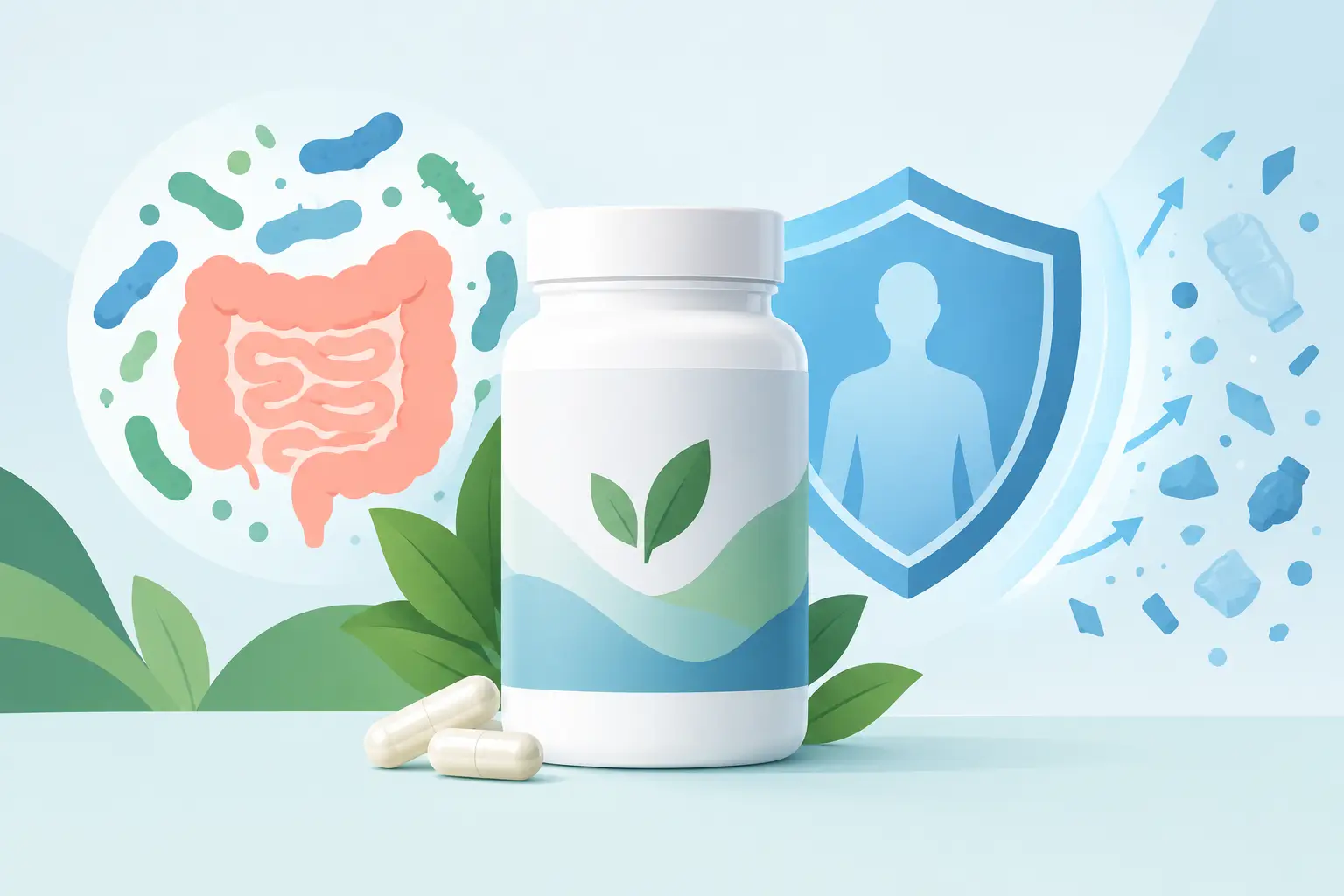
The plastic bottle you refill, the takeout container you heat, and the air moving through your home all point to the same uncomfortable reality: plastic exposure is part of everyday life. This postbiotic formula review looks at a different kind of digestive supplement – one designed not simply to support gut balance, but to help address microplastic particles after they enter the digestive tract.
Microplastics are small, but the concern around them is not. They have been identified in food, drinking water, and air, making total avoidance unrealistic for most people. Reducing exposure still matters, yet it does not answer the question many health-conscious adults are asking: What can I do about the particles I may already ingest?
Postbiotic Formula Review: What Makes It Different?
Most digestive formulas fall into familiar categories. Probiotics add live microorganisms. Prebiotics provide compounds that nourish beneficial bacteria. Fiber products support regularity. Traditional detox products often rely on broad, nonspecific ingredients and vague promises.
A biofilm-based postbiotic formula takes a narrower and more purposeful approach. The goal is not to claim that it removes every environmental contaminant or replaces healthy habits. Its intended role is to create an adhesive biofilm in the digestive system that can trap and bind plastic particles, supporting their movement through normal digestive elimination.
That physical mechanism is the central distinction. Think of the biofilm as a magnet-like protective layer. As particles move through the gastrointestinal tract, the biofilm is designed to interact with them, hold them in place, and help carry them out through the body’s normal digestive process.
This is why the category deserves a closer look. General gut-health supplements can be useful, but they are not necessarily engineered around microplastic defense. A postbiotic formula built for this purpose is aimed at a modern exposure problem with a specific digestive strategy.
Why Biofilm Technology Matters
Biofilms are naturally occurring communities or layers created by microorganisms. In the right context, they can adhere to surfaces and interact with materials around them. The technology behind this type of formula uses a proprietary postbiotic/probiotic strain selected for its ability to form an adhesive biofilm within the digestive environment.
The value of this approach is its focus on contact and binding. Microplastics do not need to be digested for a formula to potentially help manage them. Instead, the formula is designed to create a physical association with particles present in the gut, then support their routine elimination.
Laboratory findings associated with Qi601 Biofilm Shield™ technology have shown up to 98% binding of plastic particles under tested conditions. That is a meaningful performance signal, but it should be read responsibly. Laboratory conditions are controlled, while human diets, transit times, microbiomes, exposures, and health histories vary. A strong lab result supports the proposed mechanism. It does not mean that every person will experience the same degree of binding or elimination.
That distinction matters because credible supplement education should not overpromise. No capsule can create a plastic-free life. The practical objective is to add a targeted daily layer of defense while continuing to make sensible exposure-reduction choices.
What to Look for in a Postbiotic Formula
A serious formula should make it clear what it is designed to do and how it is designed to do it. Broad claims about cleansing, purity, or detoxification are not enough when the issue is microplastic exposure. Look for a defined mechanism, transparent language around intended use, and evidence connected to the actual technology rather than generic gut-health research.
Doctor-led development also matters. Digestive products are not interchangeable, especially when they are positioned around a physical binding mechanism. Consumers should want to know whether a formula was developed with clinical expertise, whether it has been evaluated in humans, and whether its claims stay within appropriate supplement boundaries.
Patent depth can provide another useful signal. Patents do not prove that a product will work for every individual, but they can indicate that a company has invested in a distinct technology rather than applying a new label to a standard probiotic blend. A portfolio of more than 50 patents suggests a serious effort to develop and protect a specific platform.
Finally, daily usability should not be overlooked. Microplastic exposure is not a one-time event. It is ongoing. A formula intended to support digestive elimination of particles needs to fit into a consistent routine, not require a complicated cleanse, restrictive fast, or rotating protocol.
The Real-World Trade-Offs
The strongest reason to consider a biofilm-based postbiotic is also the reason to keep expectations grounded. It is a targeted tool, not a substitute for an exposure-reduction plan. Choosing glass or stainless steel when practical, avoiding heating food in plastic, filtering drinking water where appropriate, and prioritizing minimally processed foods can all help reduce the amount of plastic entering daily life.
But exposure reduction has limits. Parents cannot control every school lunch package. Frequent travelers cannot choose every food container. Busy professionals cannot eliminate every source of contact in restaurants, offices, or public spaces. For people who want an action beyond avoidance, a daily digestive defense may be more realistic than trying to engineer a perfect environment.
Individual digestive tolerance is another consideration. Even well-designed supplements can affect people differently, particularly those with sensitive digestion, existing gastrointestinal conditions, allergies, or complex medication routines. If you are pregnant, nursing, managing a medical condition, or taking prescription medications, speak with a qualified healthcare professional before adding a new supplement.
A targeted postbiotic formula also should not be treated as a treatment for disease. It is intended to support normal digestive function and the body’s routine elimination process, not diagnose, cure, mitigate, treat, or prevent any disease.
Who May Find This Approach Useful?
This category is especially relevant for people who already think proactively about environmental exposures and long-term wellness. That may include the person who filters water at home, reads ingredient labels, uses glass storage containers, and still recognizes that microplastics are difficult to avoid completely.
It may also fit people who want a more defined purpose from their daily gut-health routine. Rather than taking a general probiotic and hoping it covers every concern, they may prefer a formula engineered around one clear objective: helping trap and bind plastic particles in the digestive tract.
For others, the decision will depend on priorities. If your primary goal is occasional digestive comfort, fiber intake, or microbiome diversity, a conventional gut-health product may be a better fit. If microplastic exposure is the concern you cannot solve through lifestyle changes alone, biofilm technology offers a more direct response.
A Practical Standard for Evaluating Claims
The best postbiotic formula review should leave room for both urgency and discernment. Plastics do not belong in your body, and minimizing unnecessary exposure is a sensible health decision. At the same time, supplement claims deserve scrutiny.
Ask whether the brand explains its mechanism in plain language. Ask whether laboratory findings are presented as laboratory findings rather than guarantees. Ask whether human testing, doctor development, manufacturing standards, and intellectual property are described with enough specificity to evaluate. Most of all, ask whether the product addresses the problem you actually want to solve.
Microplastic exposure can feel overwhelming because it is woven into modern life. A focused daily formula cannot erase that reality, but it can turn concern into a practical routine. The most useful next step is not panic or perfection. It is choosing credible tools, using them consistently, and giving your digestive defense the same attention you already give to the water you drink and the food you bring home.