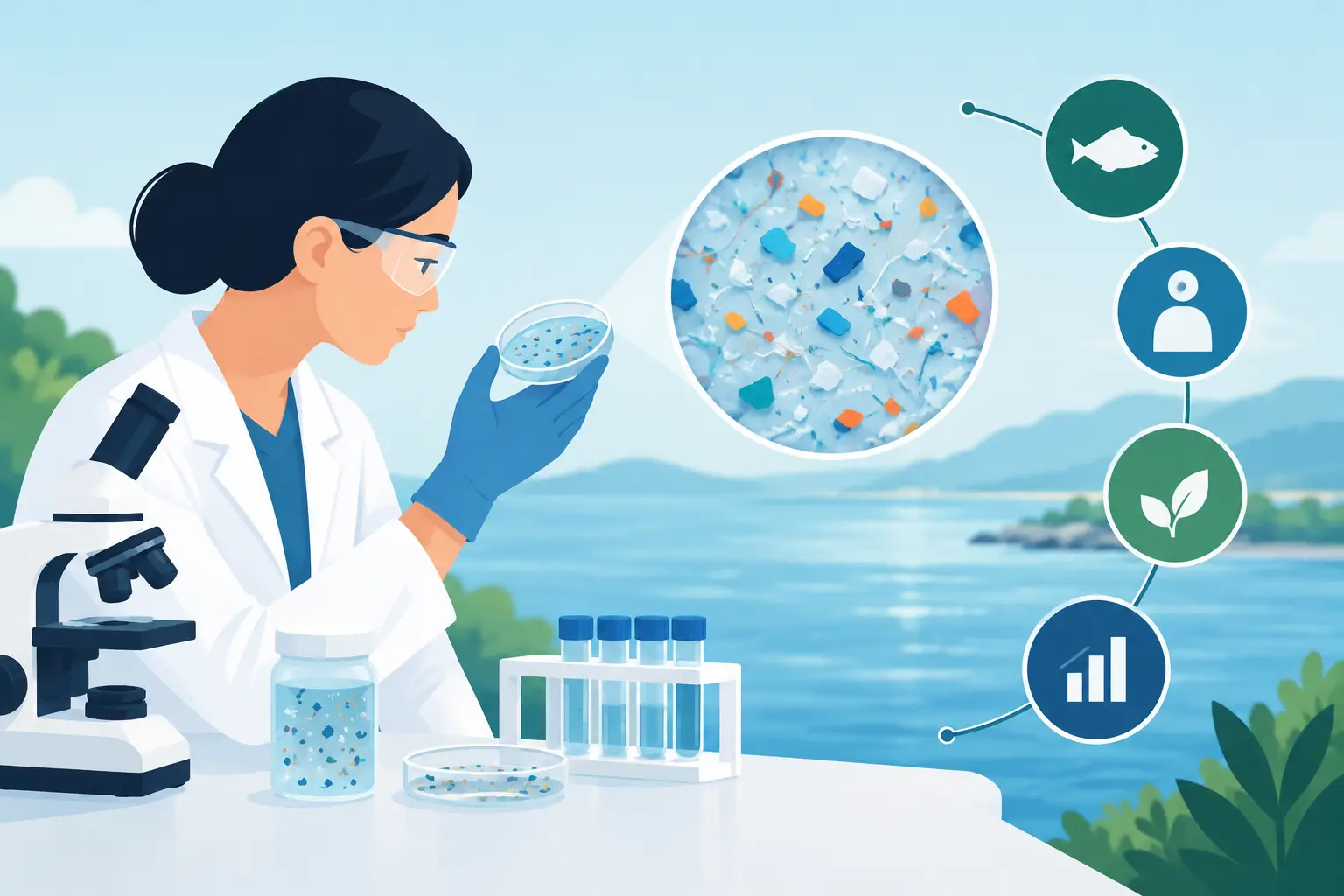
Plastic exposure is not a future problem waiting at the door. Micro- and nanoplastic particles are encountered through food, water, packaging, household dust, and air. That reality is why biofilm clinical research matters: consumers deserve more than broad detox language when they are looking for a practical way to support their body’s normal digestive elimination.
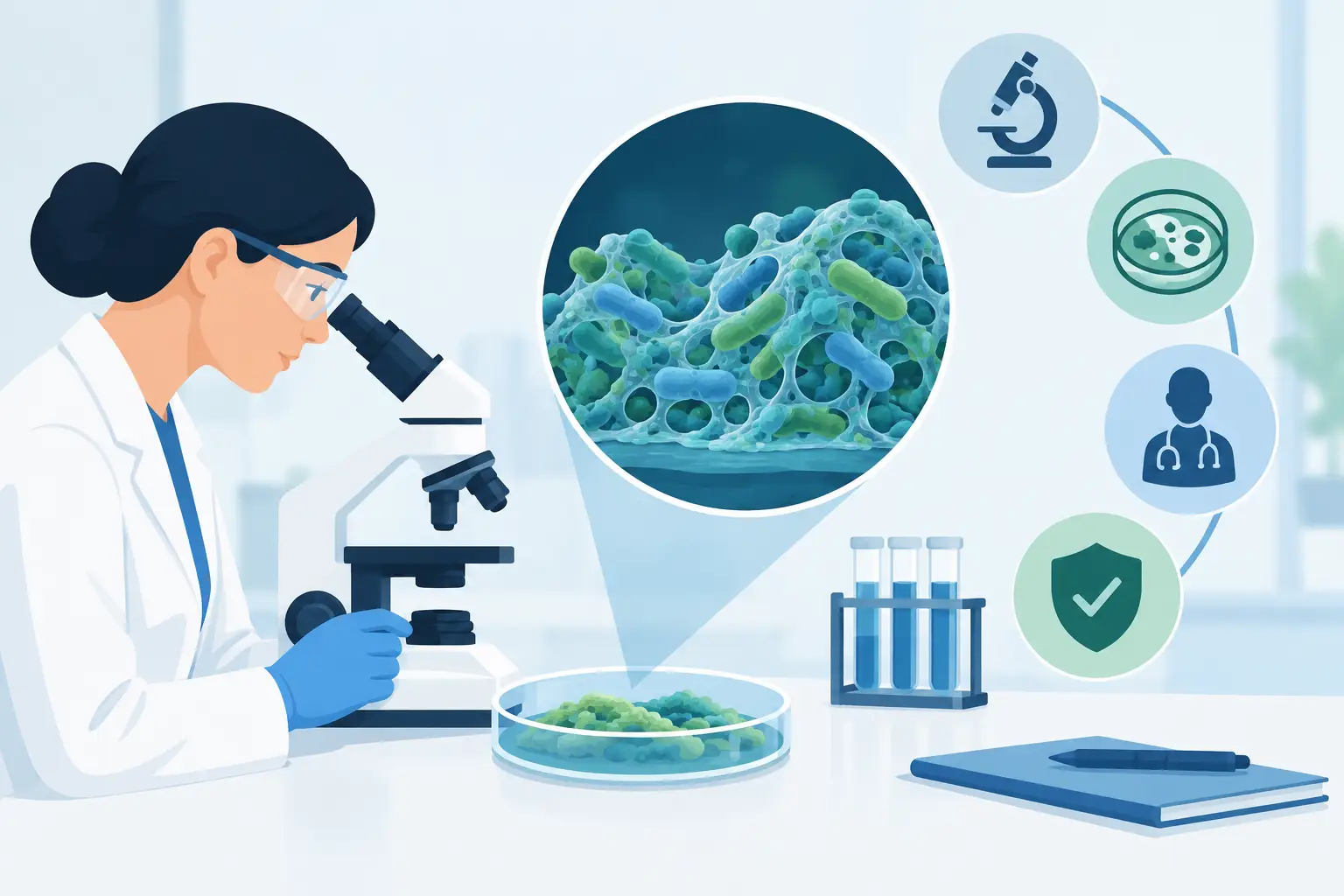
A biofilm is not simply a marketing term for gut health. It is a structured community of microorganisms and their protective matrix. In the right application, that matrix may act as a physical interface in the digestive tract – creating a surface that can interact with particles moving through the gut. The scientific question is straightforward but demanding: Can a targeted biofilm safely bind relevant particles under real digestive conditions and help move them out through normal digestion?
That question cannot be answered by a single lab image, an ingredient list, or a vague promise. It requires evidence that follows the mechanism from the bench to the human body.
Why Biofilm Clinical Research Is Different
Most digestive supplements are evaluated through familiar outcomes: regularity, bloating, microbial composition, or general comfort. Those outcomes can be useful, but they do not establish a particle-binding mechanism. A product positioned for microplastic exposure support must be studied for what makes it distinct.
Biofilm clinical research should examine whether the biofilm forms and remains active in conditions that resemble the gastrointestinal environment. It should also test whether the material can bind the specific size ranges and polymer types under consideration, rather than only performing well against a convenient model particle in a simplified solution.
The distinction matters because the digestive tract is not a clean glass container. It is a moving, chemically active system with changing acidity, enzymes, bile salts, food particles, mucus, and an existing microbiome. A finding from a controlled laboratory assay can be valuable, but it is the beginning of the evidence story, not the end.
The Evidence Chain That Deserves Your Attention
The strongest programs connect laboratory work, safety evaluation, and human testing. Each step answers a different question, and no single step can replace the others.
Laboratory testing establishes the mechanism
In vitro testing can show whether a biofilm or postbiotic/probiotic-derived matrix physically associates with plastic particles. Researchers can examine binding rates, compare particle sizes, study different polymers, and observe how the interaction changes in simulated digestive fluids.
This is where numbers such as binding percentages belong. They should be interpreted carefully. A high binding result can demonstrate promise, but consumers should ask what was tested, at what concentration, under what conditions, and whether the test modeled digestion in a meaningful way. A claim that a system binds up to 98% of particles, for example, describes a laboratory result under defined conditions. It does not mean every particle a person encounters will be captured.
Safety data establishes the baseline
A proposed daily digestive defense has to be tolerable and appropriate for repeated use. Researchers need to assess the strain or postbiotic material itself, its manufacturing quality, potential interactions, and common digestive effects. For products containing live microorganisms, strain-level identity is especially important. “Probiotic” is not a blank check. Effects can vary substantially between strains.
Safety also includes asking whether the binding approach behaves selectively enough to be useful. A physical binding mechanism should be studied for its potential relationship with nutrients, medications, and other compounds in the digestive tract. Timing guidance may be appropriate depending on the formulation and evidence available.
Human research establishes relevance
Human testing is where a compelling mechanism faces real life. Participants eat normal meals, have different microbiomes, take medications, and experience variable exposures. Well-designed studies can evaluate tolerability, adherence, digestive outcomes, and markers related to particle passage when valid measurement methods are available.
The best human studies clearly define who participated, how long the intervention lasted, what the comparison group received, and how outcomes were measured. A randomized, controlled design is generally more informative than anecdotes alone because it helps separate the effect of an intervention from normal variation, expectation, and changes in behavior.
What a Meaningful Clinical Study Should Measure
There is no single universal test for microplastic exposure support. The field is still developing methods for detecting and characterizing tiny particles in complex biological samples. That makes transparency more valuable, not less.
Researchers should explain the analytical methods used to identify particles. Size threshold matters: microplastics and nanoplastics behave differently, and very small particles are especially challenging to measure. Polymer identification matters too. A study that measures total debris without distinguishing plastic from other material may not answer the central question.
Study duration also depends on the claim. A short trial may be appropriate for assessing tolerability and early digestive effects. It is less suited to making broad claims about long-term exposure outcomes. Likewise, a study of healthy adults may not apply automatically to every population, especially people with significant digestive conditions, those who are pregnant or nursing, or those taking prescription medications.
Good clinical research does not eliminate every uncertainty. It identifies the uncertainty, measures what can be measured, and avoids claiming more than the data can carry.
Why “Detox” Needs a Physical Explanation
Consumers have learned to be skeptical of detox claims for good reason. Many are built around undefined toxins, dramatic language, and no measurable pathway. The more useful question is not whether a product uses the word detox. It is whether it explains a plausible, testable process.
For a biofilm-based approach, the proposed process is physical: a targeted biofilm matrix interacts with particles in the gastrointestinal tract, binds them, and supports their passage through normal digestive elimination. Think of it less as forcing the body to purge and more as adding a protective capture surface where exposure is often encountered.
That mechanism has boundaries. A digestive supplement is not a medical treatment for disease, and it cannot erase the reality of environmental exposure. It also should not encourage people to ignore basic exposure-reduction practices, such as choosing lower-plastic food storage when practical, filtering drinking water where appropriate, and limiting unnecessary heating of food in plastic.
But exposure reduction alone has a hard limit. Plastic is woven into modern life. A daily, well-studied digestive strategy can give people a practical layer of support without demanding perfection from their homes, diets, or schedules.
Reading Research Without Getting Buried in Jargon
You do not need a laboratory degree to ask better questions. Start with whether the research aligns with the product’s stated mechanism. If the product says it traps particles, look for testing that actually evaluates particle binding. If it says it works in the digestive tract, look for digestive-condition models and human evidence rather than a claim based only on a general probiotic benefit.
Then look at the language. “Supports normal digestive elimination” is different from “removes all microplastics from the body.” The first describes a bounded structure-function role. The second is an absolute claim that current science would struggle to substantiate.
Finally, consider whether the company is willing to be specific. Named technology, documented development, clear ingredient identity, quality manufacturing, and transparent study descriptions are stronger signals than a label built entirely on fear. Urgency is appropriate when the exposure is widespread. Precision is what makes the response credible.
A Protective Standard for a New Exposure Problem
Microplastic exposure has created a category of concern that conventional wellness routines were not designed to address. Fiber, hydration, nutritious food, and healthy digestion remain foundational, but they were not specifically engineered to bind plastic particles. The next generation of digestive health research must be more exact.
Qi601’s Biofilm Shield technology reflects that direction: a biofilm-based approach designed to trap, bind, and support the normal digestive elimination of micro- and nanoplastic particles. Its value rests on the same standard every serious innovation should meet – a clear mechanism, laboratory validation, human testing, and careful claims that respect the limits of the evidence.
Plastics do not belong in your body. You may not be able to control every exposure, but you can demand research that turns concern into a defensible daily action – one grounded in measurable biology, not empty reassurance.